The most recent local elections in North Macedonia in 2025 produced a paradox that is becoming increasingly difficult to ignore. Namely, on one hand, the elections were competitive, opposition parties remained politically present and relevant, and voters were offered political alternatives. On the other hand, however, many of the indicators of democratic connection such as citizen participation, representation and institutional confidence, remained visibly fragile.
This dialectic matters because the central democratic question facing North Macedonia is not whether elections take place or whether parties compete. Both are true. The more difficult question is what kind of relationship exists between citizens, institutions and political actors once electoral competition itself becomes normalized, while democratic confidence remains weak.
The OSCE/ODIHR observation mission described the local elections as competitive and generally respectful of fundamental freedoms, but its findings also pointed toward structural imbalances surrounding the process. Observers noted unequal campaign conditions, allegations of pressure on public-sector employees, weaknesses in campaign-finance oversight and political advertising rules that disproportionately favored parliamentary parties over smaller political actors and independent candidates.
None of these issues fundamentally undermined electoral competition. But together they revealed something more significant: competitive elections and democratic confidence are not necessarily the same thing.
This distinction increasingly shapes political life in many post-transition democracies. Electoral systems may stabilize procedurally while public trust, representation and political attachment remain uneven. Elections are held, governments change through ballots rather than crisis, and political competition survives. Yet beneath that procedural stability, the relationship between citizens and democratic institutions often appears increasingly thin.
The local elections exposed precisely this kind of disconnect.
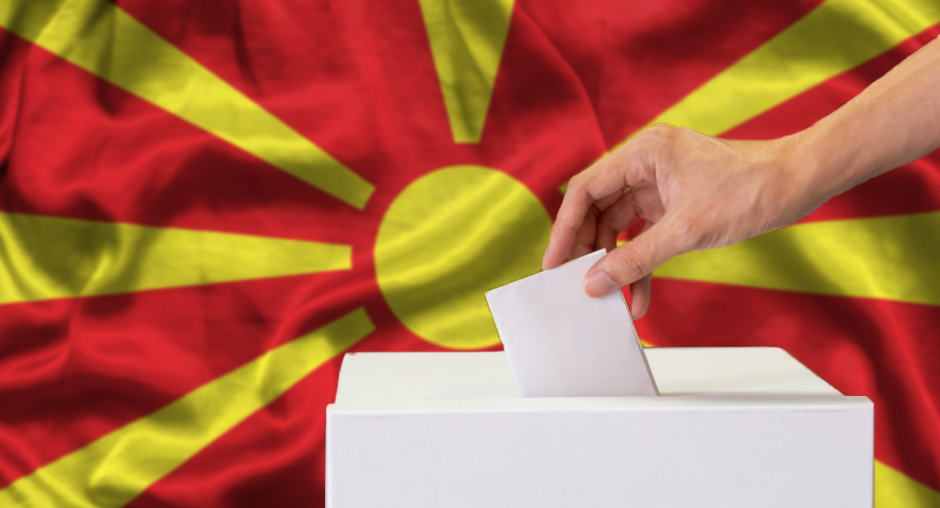
Source: https://www.biepag.eu/blog/what-just-happened-in-north-macedonia-2021-municipal-elections-and-their-aftermath/
Democratic participation without attachment
One of the clearest examples was participation itself. First-round turnout for the local elections in North Macedonia reached 48.46 percent nationally,which is comparatively lower than previous local elections in 2021. In addition, in four municipalities mayoral elections had to be repeated because fewer than one-third of registered voters participated, thus not meeting the set threshold. The issue was not simply turnout, but what uneven participation suggests about broader democratic engagement.
Survey findings from the Comparative Study of Electoral Systems conducted after the 2024 parliamentary and presidential elections help in understanding the wider political environment and provide a broader context. More than half of respondents stated that they did not feel close to any political party, and at the same time, most reported voting for the same party across elections. The most concerning is the prevailing high distrust toward political institutions and socio-political actors. Attitudes toward the electoral process itself stand out as comparatively more positive, with citizens generally being confident that elections are fairly conducted.
Among citizens who abstained from voting, many explained their decision not through ideological opposition, but through political detachment and the belief that electoral outcomes do not substantially change how politics functions in the country.
This is not the absence of democracy. It is something more ambiguous and, in many ways, more difficult: participation without attachment. Citizens continue to vote, but increasingly without confidence that institutions or parties meaningfully represent them.
The dominance of major political parties during the local elections reinforced this perception. Municipal contests increasingly resembled extensions of national partisan competition rather than autonomous local democratic representation. Political infrastructure, media visibility and organizational capacity remained heavily concentrated among established parliamentary actors, while independent candidates and smaller parties entered the campaign under visibly weaker conditions.
Formal rules, uneven outcomes
Questions of accountability further complicated the picture. ODIHR observers noted that roughly two-thirds of electoral participants failed to submit interim campaign-finance reports during the campaign period, while oversight institutions initiated no formal proceedings. The issue was not simply administrative noncompliance. It reflected a broader weakness in democratic accountability precisely in areas where public trust is already fragile.
The absence of enforcement is as telling as the noncompliance itself. When oversight institutions do not act, the message conveyed to political actors is not only that violations carry no consequence, but that accountability mechanisms are selectively applied. This reinforces the perception that formal rules and actual political practice operate differently. This gap between legal framework and institutional behavior is precisely what erodes public confidence and trust over time, independent of any single electoral outcome.
Representation revealed a similar imbalance. Women remained visibly present on municipal council lists, largely due to quota mechanisms and formal inclusion rules. Yet, when executive political power was at stake, their presence declined sharply. For illustration, among 309 mayoral candidates nationwide, only 32 were women.
The contrast is politically significant because it reveals the limits of formal inclusion. Representation may improve numerically without fundamentally redistributing access to political authority. Women become increasingly visible within democratic institutions while remaining structurally underrepresented in positions where executive power is concentrated.

Source: https://www.aljazeera.com/news/2024/4/24/north-macedonia-votes-for-president-as-eu-membership-bid-looms
Elections are not enough
Taken separately, none of these issues are sufficient to define the elections as fundamentally undemocratic. Taken together, however, they point toward a broader issue increasingly visible in North Macedonia’s political system: electoral democracy appears more consolidated procedurally than socially.
This distinction matters because procedural consolidation and social consolidation do not automatically reinforce one another. A political system can achieve high levels of technical electoral competence, while simultaneously experiencing declining civic engagement, weakening party-citizen linkages, and growing detachment between formal institutions and everyday political life.
Democratic systems to be functional have to sustain public trust, meaningful representation and political inclusion beyond elections and to succeed in overcoming the social disconnect, once the electoral competition becomes a routine. For elections is not only important to be free and fair, but also to be meaningful for the ones who participate in them.
The future of democracy will depend not only on preserving competitive elections, but on rebuilding the broader democratic connection between institutions and citizens that gives electoral competition political meaning in the first place. Rebuilding democratic connection is fundamentally different from securing electoral competition. It requires the conditions where citizens trust institutions, accountability is present, and representation is not only nominal. Such conditions cannot be legally adopted into existence, instead they have to be created through interactions between citizens and the political system over time. Unfortunately, time is slipping away.
Author’s Biography
Tea Cvetanovska holds a master’s degree in European and global studies from the University of Padua, Italy, and a bachelor’s degree in International relations and diplomacy. She is a researcher and a project associate at the Macedonian Center for International Cooperation on a regional good-governance and anticorruption project. Her research and professional interests focus on EU integration, enlargement, democracy, good governance and elections. She has also been a research fellow at the Historical Archives of the European Union, and she has experience participating in ODIHR election observation missions

The Compliance-Capture Bargain: How the Western Balkans Learned to Pass the Test Without Passing the Course

Društvena polarizacija kao izvor nestabilnosti na Balkanu

Tekst Alekse Nikolića Venecijanska komisija kao međunarodni ustavni sud

Iranizacija u Bugarskoj (4)
Iranizacija na Kosovu (3)
Iranizacija i Albanija (2)
Iranizacija na Balkanu (1)
Alternative Models of Development Assistance
ETNOPSIHIČKE KARAKTERISTIKE BALKANSKIH NARODA PROKLETSTVO ILI DAR II deo – dar
Etnopsihičke karakteristike balkanskih naroda – prokletstvo ili dar I deo – prokletstvo